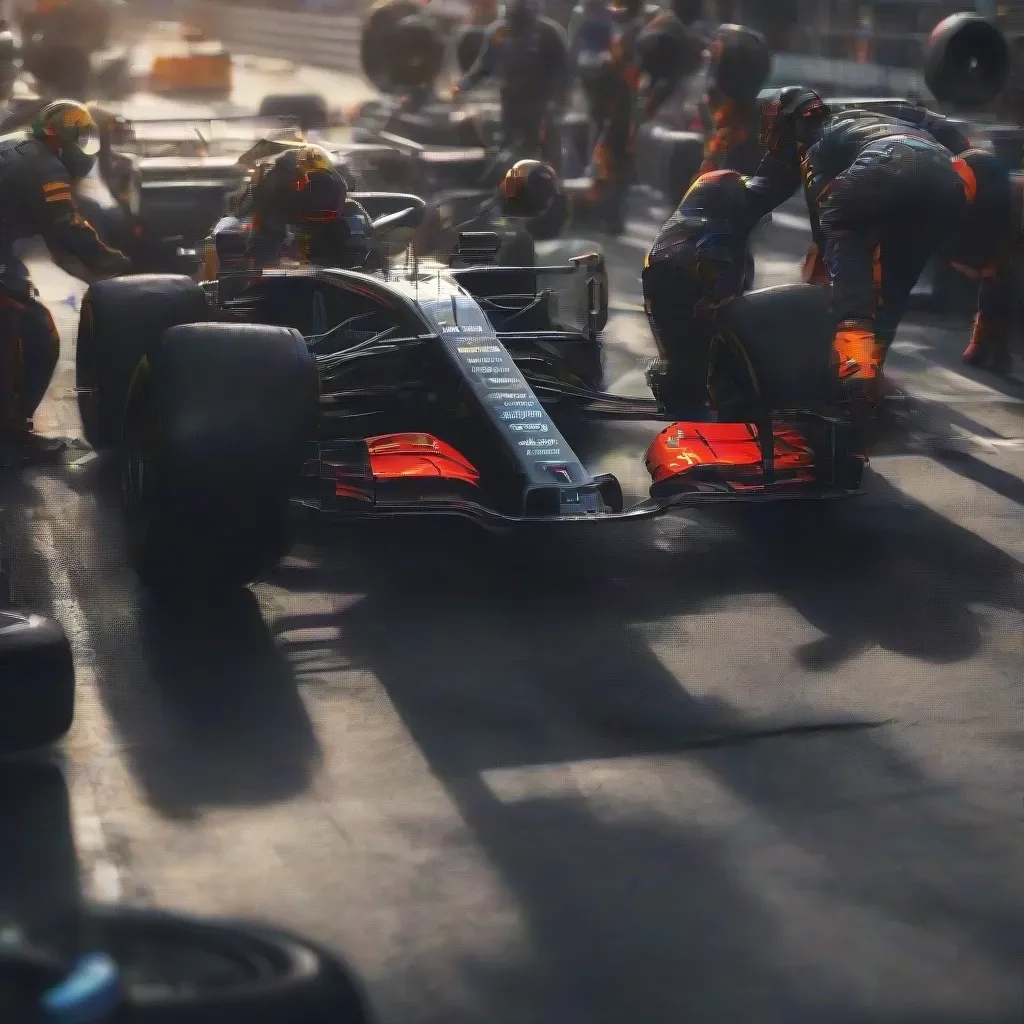
Remember that heart-stopping moment when a botched pit stop snatched victory from what seemed like a sure win? Picture the scene: the roar of the crowd, the finely tuned engine screaming for release, and then… disaster. A misaligned wheel nut, a fumble with the fuel hose, and suddenly the race is no longer yours.
Pit stops are more than just a pause; they represent perfect choreography under immense pressure. It’s a convergence point where races are won and lost, and championships hang in the balance. Globally, the Formula 1 community recognizes a pit stop as the pivotal moment where human skill meets machine precision. It’s million-dollar decisions unfolding in mere seconds.
This article peels back the layers of the F1 pit stop to understand the profound depths of strategy and its execution. You’ll learn what dictates success, the anatomy of failure, and the crucial technologies driving efficiency. Understanding the financial burden of a team’s pit stop performance will be crucial to grasping the nuances of this fast-paced sport. Get ready to explore the high-octane world of F1 pit stops, where every fraction of a second counts and every move is a calculated risk.
The Anatomy of an F1 Pit Stop
A Formula 1 pit stop is a masterclass in speed, precision, and teamwork. What appears as a blur of activity is actually a meticulously choreographed ballet involving around 20 highly trained mechanics. Each member plays a vital role, all aimed at getting the car back in the race in the shortest time possible – often under three seconds.
Here’s a breakdown of the key players and their responsibilities:
- Wheel Gunners: Armed with high-powered pneumatic wheel guns, these are the stars of the show. Their job is to rapidly remove the old wheel nut, and tighten the new one. Precision is key; too loose and the wheel could detach, too tight and the nut could be damaged, causing problems at the next stop.
- Front and Rear Jack Operators: These mechanics lift the car with incredible speed and stability. The front jack operator must be particularly quick, as he is responsible for lifting the car high enough for the tire change to occur.
- Tire Carriers: Two mechanics per tire, one to remove the old tire and one to fit the new. They must work in perfect sync.
- Lollipop Man: The conductor of the orchestra. He is responsible for releasing the car back into the race. The “lollipop” is a sign that tells the driver when it is safe to leave the pit box. He monitors the entire process and only releases the car when everything is secure.
The tools of the trade are just as crucial as the personnel. The wheel guns deliver immense torque with pinpoint accuracy. The jacks are engineered for rapid deployment and rock-solid stability. And the entire pit box is designed for efficiency, with every tool and spare part within easy reach.
The pit stop process itself is a study in choreographed chaos. As the car approaches, the crew springs into action. The jack operators lift the car, the wheel gunners attack the wheel nuts, the tire carriers swap the rubber, and the lollipop man watches over it all. It all happens in a matter of seconds.
Considering the complexity, and the speed at which all of that happens, it really is a spectacle to behold.
Common Pit Stop Mistakes and Their Consequences
Pit stops, despite their seemingly simple nature, are a hotbed for potential errors that can dramatically alter a race’s outcome. The pressure-cooker environment, combined with the sheer physicality and speed required, creates a perfect storm where even the most seasoned teams can falter.
One of the most frequent culprits is the dreaded wheel gun malfunction. These high-powered tools are essential for quickly removing and tightening lug nuts, but they’re prone to issues. A worn-out mechanism, a faulty socket, or even a momentary lapse in concentration by the crew member can lead to a failure. The consequence is immediate: wasted seconds, a delayed departure, and often, a lost track position. For the driver, it’s a frustrating experience, knowing that valuable time is slipping away. From the team’s perspective, it ignites a scramble to diagnose the problem and recover lost ground, potentially forcing a change in race strategy.
Cross-threading lug nuts is another common pit stop error with significant consequences. This occurs when the lug nut is not properly aligned with the wheel stud, causing damage to the threads. The result is difficulty tightening the nut, leading to a wobbly wheel and, in extreme cases, a wheel detachment on the track. The danger here is obvious and the ripple effects include immediate retirement from the race, substantial penalties, and a complete rethink of the team’s pit stop procedures to prevent recurrence.
Slow Fueling can also ruin a race for a team. There are a number of things that can happen, like a bad seal, debris in the fuel or a problem with the pump. In any of these cases, what could have been an extraordinary race, can turn into a nightmare in a matter of seconds.
The Cost of Milliseconds: Quantifying the Impact
In the high-stakes arena of motorsports, victory is often measured not in seconds, but in mere milliseconds. What might seem like an insignificant delay can cascade into a dramatic shift in lap time, track position, and ultimately, the accumulation of crucial championship points. Data analysis and simulation tools reveal the stark reality: these tiny fractions of a second hold immense power over race outcomes.
Consider a scenario where a delayed pit stop of just half a second can be the difference between maintaining the lead and emerging behind a key rival. That half-second translates directly into lost track position, forcing the driver to expend valuable time and energy attempting an overtake – a maneuver that carries its own risks and potential for further time loss. Over the course of a race, these accumulated milliseconds can easily add up to seconds, pushing a contender down the leaderboard and jeopardizing their chances of a podium finish.
To put this into perspective, think about needing to quickly find the right document on your computer–a delay of a even a few seconds makes one less likely to find it. Similarly, in racing, small things can make a huge difference. Championship points are the lifeblood of any racing team, and the loss of even a few points in a single race can have a ripple effect, impacting their overall standing and potentially costing them the championship title. Milliseconds matter; they are the currency of speed and success.
Team Strategies for Minimizing Pit Stop Errors
Formula 1 teams relentlessly pursue perfection in every aspect of racing, and pit stops are no exception. Minimizing errors requires a multifaceted approach encompassing proactive strategies and reactive adjustments, all fueled by data and a commitment to continuous improvement. These strategies revolve around intensive training, cutting-edge technology, and meticulous data analysis.
The cornerstone of pit stop proficiency is rigorous training. Pit crews undergo intense regimens, including simulated pit stops that mimic race-day pressure. These simulations are not just about speed; they focus on consistency and precision. Crews practice specific scenarios, drilling every movement until it becomes second nature. Some training focuses on reacting to unexpected issues, like a jammed wheel nut or a fuel spillage. This ensures that the team is prepared for almost anything that could occur during a pit stop. The goal is to build muscle memory and team cohesion, so that during the heat of a race, the crew operates like a single, well-oiled machine.
Beyond training, teams leverage advanced technology to enhance their pit stop performance. Sensors and cameras capture every millisecond of the pit stop, generating a wealth of data. This data is then analyzed to identify areas for improvement, whether it’s optimizing the choreography of the crew or refining the design of the wheel guns. By understanding the nuances of each pit stop, teams can implement data-driven adjustments. This ensures that they are always operating at peak efficiency. This is the approach that separates the good teams from the great.
High-Pressure Situations: The Human Element
Beyond the roaring engines and split-second decisions, the pit lane is a crucible of human endeavor, where psychological factors can make or break a race. The pressure on a pit crew is immense. Fatigue gnaws at concentration after hours on the road and in the garage. Stress mounts as the race intensifies, and the weight of responsibility settles heavily knowing that a fumble can cost the team valuable points, or even the race itself.
Human error, while inevitable, is magnified under these conditions. Every member needs mental thoughness. It’s not just about physical prowess; it’s about maintaining composure when everything is on the line. Teams recognize this and invest in the psychological well-being of their crews. Stress management techniques become as crucial as tire changes. Team-building exercises forge bonds that help crew members support each other under pressure.
I’ve witnessed firsthand how a seemingly minor lapse in concentration could snowball into a costly mistake. The aim is to cultivate resilience, quickly recover from setbacks, and maintain focus. The pit crew are not robots; they are athletes facing extreme mental and physical demands. Recognizing this and addressing the human element is paramount to success in the high-stakes world of motorsports.
Technological Advancements in Pit Stop Automation
The relentless pursuit of shaving milliseconds off pit stop times has fueled a revolution in automation and robotics within motorsports. The humble wheel gun, once a purely manual tool, is now a sophisticated piece of engineering, boasting computer-controlled torque settings and sensors that ensure perfect lug nut engagement every time. This precision reduces the risk of cross-threading or under-tightening, both of which can have disastrous consequences on the track.
Beyond the wheel gun, sensor technology is playing an increasingly vital role. Pressure sensors embedded in the air jacks can automatically signal when the car is fully lifted, optimizing tire changes. Optical sensors can detect the precise moment a fuel nozzle connects, preventing spills and ensuring consistent fuel delivery. These seemingly small enhancements, when combined, contribute significantly to overall pit stop efficiency.
Looking further ahead, artificial intelligence (AI) promises to transform pit stops even more drastically. AI-driven systems could analyze sensor data in real-time, providing pit crews with actionable insights to improve their performance. Imagine a system that can predict optimal tire pressures based on track conditions and driving style, or one that can identify the slightest anomaly in a wheel bearing before it leads to a failure. While truly fully-automated pit stops, devoid of human involvement, may still be a distant prospect due to the complexities and unpredictability of racing, the integration of AI and robotics will undoubtedly continue to push the boundaries of what’s possible, improving both speed and reliability.
Case Studies: Races Lost and Won in the Pits
Formula 1 isn’t just about roaring engines and daring overtakes; it’s a high-stakes chess match played at 200 mph, where pit stop performance can be the ultimate kingmaker… or the undertaker of dreams. Examining particular races reveals how critical decisions in the pits can dramatically alter the course of events.
2025 Azerbaijan Grand Prix: A Blunder in Baku
The 2025 edition of the Azerbaijan Grand Prix will be remembered for a pit stop miscue that cost Lando Norris a potential victory. Leading comfortably, Norris pitted on lap 22. A delayed release due to a cross-threaded wheel nut added agonizing seconds to his stop. This pit stop disaster allowed Max Verstappen, who pitted cleanly, to snatch the lead and ultimately win the race. Analysis showed Norris’s pit stop was nearly 4 seconds slower than Verstappen’s. This pit stop was the difference between a win and second place.
2025 Italian GP: McLaren’s Pit Stop Nightmare
Monza, the temple of speed, transformed into a house of horrors for McLaren at the 2025 Italian Grand Prix. Both McLaren drivers suffered horrendous pit stops due to a system failure that affected the wheel guns. The delays relegated both drivers out of points-paying positions. Oscar Piastri, who had been running strongly in the top 7, lost almost 20 seconds in the pits. While the drivers put on a brave face, the pit stop disaster effectively ended McLaren’s chances of a strong points finish. The race highlighted the need for failsafe mechanisms and rigorous testing of pit stop equipment.
The Future of F1 Pit Stops: Trends and Predictions
The landscape of Formula 1 pit stops is on the cusp of a revolution, fueled by evolving F1 regulations, rapid technology trends, and increasingly sophisticated pit stop strategies. Looking ahead, several key factors will likely reshape how these crucial moments unfold.
One major influence will be the 2026 Formula 1 regulation changes, which will likely dictate fresh parameters for car design and potentially, pit stop procedures. Teams will need to adapt their strategies and technologies to comply with these new rules, possibly leading to innovations in equipment and technique.
We can expect further integration of data analytics and AI to optimize pit stop performance. Real-time data will inform split-second decisions, enhancing efficiency and minimizing errors. Moreover, the relentless pursuit of faster, more reliable equipment will continue, with advancements in areas like wheel gun technology and automated systems. Ultimately, the future of F1 pit stops will be defined by the synergy between human skill and technological innovation, pushing the boundaries of what’s possible in the high-stakes world of motorsport.
Conclusion
In the relentless pursuit of F1 excellence, the pit stop stands as a critical battleground where races are won and lost. Precision, teamwork, and cutting-edge technology converge in a fleeting moment, holding the power to make or break a driver’s championship aspirations. As evidenced by Lando Norris’s projected 2025 World Championship victory, facilitated by his team’s pit stop prowess, mastering the art of the pit stop remains an indispensable ingredient in the winning formula.